The incident has also renewed attention on the complex identity politics surrounding the Thadou community.
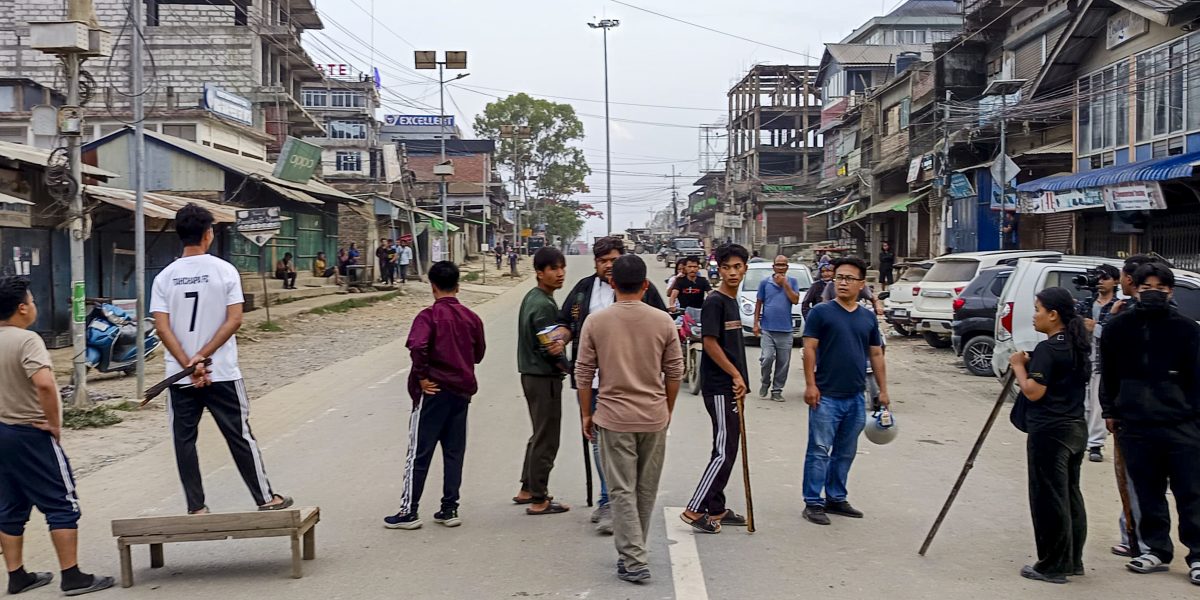
People block a road after the normal life was paralysed by shutdowns called by the Kuki Zo and Naga communities against the killing of three church leaders and a civilian on Wednesday in Kangpokpi, in Churachandpur, Manipur, Thursday, May 14, 2026. Photo: PTI.
New Delhi: The killing of three tribal church leaders in Manipur on May 13 has once again deepened tensions in the violence-hit state, just days before Chief Minister Yumnam Khemchand Singh is scheduled to visit Churachandpur.
The May 13 attack took place when leaders of the Thadou Baptist Association of India (TBAI) and the United Baptist Council (UBC) were returning from a Baptist convention in Churachandpur to Kangpokpi district. According to survivors, unidentified gunmen opened fire on their two vehicles between Kotlen and Kotzim villages, at around 10 am.Backward Skip 10sPlay VideoForward Skip 10s
Advertisement
The incident occurred on the hilly Tiger Road.
Among those killed were TBAI president Reverend Vumthang Sitlhou, TBAI finance secretary Reverend Kaigoulun Lhouvum, and a pastor, Paogoulen Sitlhou.
A total of eight people were travelling in two vehicles. One of the survivors, Hekai Simte, told The Wire that the firing continued “non-stop for at least a minute” before suddenly ceasing. Simte, 56, was sitting in the second vehicle and managed to survive from the attack. “All the attackers had sophisticated weapons and that’s why they were able to shoot from a long distance,” Simte said.
While members of both the Meitei and Kuki communities have blamed each other for the attack, several questions remain unanswered. Simte told The Wire that the firing came “from the hillside”. The location of the attack has drawn attention because, despite Union home minister Amit Shah’s push for “free movement” across Manipur, Meitei groups largely do not have access to the hill districts, while Kukis remain unable to move freely in the valley areas. The exact circumstances of the killings, and who carried them out, are now central to the investigation.
Advertisement
Also read: On Day One of ‘Free Movement’, Clashes Kill Kuki Man, Hurt 48 Kuki People, 27 Security Personnel
The killings have shocked tribal communities across the state, particularly because Sitlhou had recently led a delegation of Kuki Christian leaders to neighbouring Nagaland in an effort to broker peace between Kukis and Tangkhul Nagas in the restive Kamjong and Ukhrul districts of Manipur.

The incident has also renewed attention on the complex identity politics surrounding the Thadou community. While some Thadou organisations maintain that they are a distinct community and not a constituent of the larger Kuki tribal grouping, others identify themselves as part of the larger Kuki-Zo people. Simte, one of the survivors, identifies himself as Thadou Kuki.
The killings are politically significant as well. Kangpokpi district is represented by Nemcha Kipgen, who became Manipur’s first woman deputy chief minister under the new government led by Chief Minister Yumnam Khemchand Singh. Since assuming office, however, Kipgen has largely remained absent from public interactions and has not addressed the media regarding the continuing ethnic conflict in the state.
In a statement on X, Manipur Police said, “In an unprovoked firing by unidentified gunmen upon two vehicles plying along Saheibung village under New Keithelmanbi-PS, Kangpokpi district on 13.05.2026, three civilians were killed and four others injured. Cordon and search operations have been launched by security forces at the surrounding area to nab those involved in the crime.”
Advertisement
However, none of the attackers have been arrested by the agencies operating in the state.
Condemnation across the Northeast
Chief Minister Khemchand Singh appealed for calm following the attack, urging people “to uphold peace, show restraint and refrain from emotional responses”. He also said that the state government would use “every resource” to identify and prosecute those responsible for the killings.
Leaders from both Kuki-Zo and Naga political groups condemned the attack in strong terms.
Nine members of the Naga Legislature Forum, including Deputy Chief Minister Yanthungo Patton, described the incident as a “cold-blooded murder” and demanded immediate action against the perpetrators. Kuki-Zo legislators, led by Nemcha Kipgen, called the ambush a “direct assault on peace” and appealed for restraint to prevent further escalation.
Advertisement
The killings also drew condemnation from neighbouring northeastern states. Neiphiu Rio, Conrad K. Sangma and Lalduhoma all expressed grief and condemned the attack.
Since ethnic violence erupted in Manipur in May 2023 between the Meitei and Kuki communities, churches have become central to the daily lives of displaced Kukis. As hundreds of villages were burned during the conflict, churches often served as shelters for families forced to flee their homes. Community leaders say more than 300 churches have been destroyed during the violence.
Despite repeated assurances from both the Union and the state government that displaced families would be rehabilitated and resettled, thousands of people continue to live in relief camps nearly three years after the conflict began.